Fire Protection Systems and Backflow Prevention in Guelph
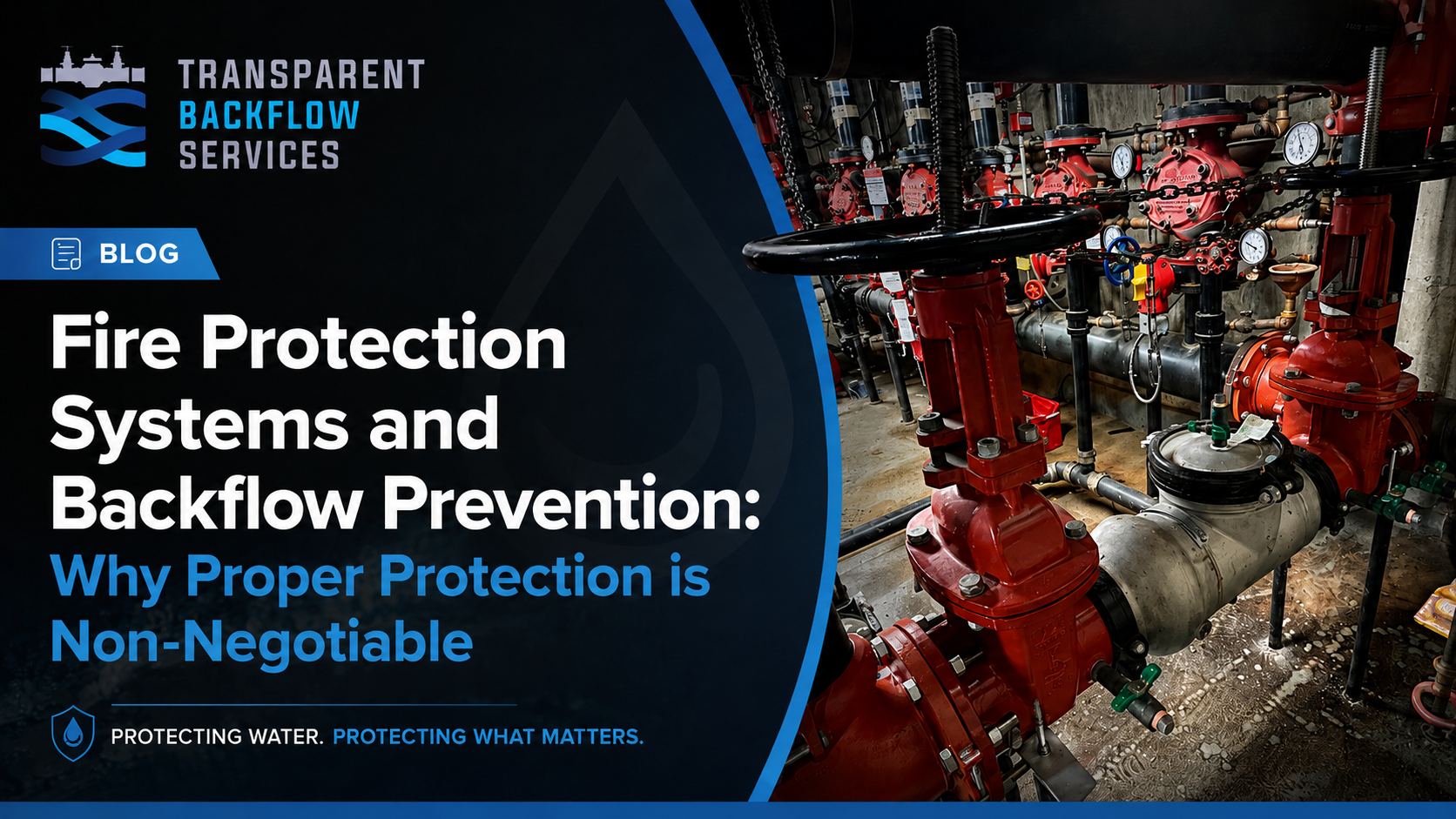
Why Proper Protection Is Mandatory
A fire protection system has one essential purpose: delivering water when a fire occurs.
However, the water sitting inside sprinkler piping, standpipes, and private fire-service lines should never be allowed to flow back into a building’s drinking-water system.
Once water enters a fire protection system, it may remain inside the piping for long periods. It can come into contact with sediment, corroding pipe, storage tanks, and other components that are separate from the potable-water system.
A properly selected backflow prevention device creates the necessary separation between the fire system and the drinking-water supply.
For commercial, industrial, institutional, and larger multi-residential properties in Guelph, this is not a minor plumbing detail. It is an important part of protecting clean water while continuing the operation of a life-safety system.
“A backflow preventer on a fire line has to protect the drinking-water supply while not compromising the fire system it serves. That is why the device cannot simply be selected by pipe size. The system design, available pressure, hazard level, and accessibility all have to be considered.”
Darryl Schwindt
Owner/Operator, Transparent Backflow Services
Fire Protection and Drinking-Water Safety Must Work Together
A building’s domestic plumbing and fire protection system may begin with the same municipal water supply, but they perform very different functions.
Domestic water is used for drinking, cooking, washing, and other everyday activities.
A fire protection system may include:
Standpipes and fire-hose connections
Fire pumps
Private fire-service mains
Private hydrants
Water-storage tanks
Antifreeze systems
Connections used during fire-flow testing
Ontario’s building and water-safety guidance recognizes fire protection systems as potential cross-connections that may require backflow protection.
The correct device must protect the potable-water supply without unnecessarily reducing the pressure or flow available to the fire system.
That balance is one reason fire-line backflow work should be completed by qualified professionals who understand both backflow prevention and the operational requirements of fire protection systems.
Why Water Inside a Fire System Is Not Considered Potable
Fire sprinkler piping can remain charged for months or years without being used during an actual fire.
Unlike domestic plumbing, the water inside the fire system does not experience regular turnover. Over time, it may be affected by sediment, corrosion, and the internal condition of the piping.
Some systems may also include fire pumps, storage tanks, or approved additives. These features can affect the level of backflow protection required where the fire system connects with the potable-water supply.
The concern is not that every sprinkler system contains visibly contaminated water. The concern is that water that has entered a dedicated fire protection system should not be assumed to remain suitable for drinking.
Backflow prevention provides a mechanical barrier that helps stop this water from returning to the potable supply during a pressure reversal.
What Can Cause Reverse Flow on a Fire Line?
Backflow can occur through back pressure or back-siphonage.
On a fire protection system, possible causes include:
A fire pump creating pressure greater than the incoming municipal pressure
Pressure changes during system testing
Sudden water demand elsewhere in the distribution system
Firefighting activity
A watermain interruption
An auxiliary water supply or storage tank
An incorrectly arranged bypass
The fire system does not need to activate during an emergency for the risk to exist.
Pressure conditions may also change during routine testing, maintenance, repairs, hydrant use, or municipal water-system activity.
Guelph Includes Fire Sprinkler Systems in Its Backflow Program
The City of Guelph specifically includes fire sprinkler systems within its Backflow Prevention Program.
All backflow devices, including those installed on fire systems, must be tested annually. These devices must also be identified during the properties cross-connection survey.
Testing is generally required:
When a device is first installed
Annually after installation
After the device is cleaned
After a repair or overhaul
After the device is relocated
The City requires test reports to be submitted to the Building Services Backflow Coordinator within 14 days of testing. A device that fails must be repaired or replaced immediately.
These requirements make the fire-line backflow preventer part of a continuous compliance program. It is not a device that should be installed and then ignored.
A Fire-System Inspection and a Backflow Test Are Different Services
Property managers sometimes assume that a sprinkler inspection automatically includes the required backflow test.
The two services are connected, but they are not the same.
A fire protection inspection evaluates the operation and condition of the sprinkler, standpipe, or related life-safety system.
A backflow test measures the performance of the backflow prevention assembly using approved testing procedures and properly maintained testing equipment.
Depending on the type of assembly, testing may determine whether:
The check valves close properly
The device retains the required pressure differential
The shut-off valves operate correctly
The relief valve responds as intended
The device can still prevent reverse flow
A backflow preventer may look normal from the outside while failing internally.
Similarly, a backflow assembly may pass its test while another component of the fire protection system requires attention. Both systems need appropriate inspection and maintenance.
Pipe Size Is Only One Part of Device Selection
Fire-service piping is often larger than normal domestic plumbing. It may appear that selecting a backflow preventer is simply a matter of fitting the assembly to the pipe diameter.
Pipe size is only one factor.
Proper device selection may also require consideration of:
The type of fire protection system
Whether a fire pump is installed
The source of the fire-system water
Whether a storage tank or auxiliary supply is present
Whether approved additives are used
The building’s hazard level
Available incoming pressure
Required fire flow
Pressure loss through the device
Drainage requirements
Access for testing and repairs
Municipal permitting requirements
The City of Guelph’s Backflow Prevention By-law requires backflow assemblies to be suitable for the identified cross-connection and installed according to applicable standards and manufacturer specifications.
An incorrectly selected device can create more than a compliance concern.
It may result in unnecessary pressure loss, be difficult to access, create drainage problems, or fail to provide the required level of protection.
Available Water Pressure Must Be Considered
Fire sprinkler and standpipe systems are designed around specific flow and pressure requirements.
Every valve, fitting, and backflow assembly creates some resistance as water moves through it. This does not mean backflow protection should be avoided. It means the assembly must be considered within the overall hydraulic design of the fire protection system.
Changing a device without reviewing its pressure-loss characteristics may affect system performance.
This is especially important when:
A fire pump is added
The existing backflow preventer is replaced with a different model
The size or type of the assembly changes
The building is expanded
A new tenant changes the use of the space
Additional sprinkler zones are added
The fire-service main is altered
The municipal water service changes
Guelph Requirements for Private Fire Protection Systems
The City of Guelph’s Water By-law includes specific responsibilities for privately owned fire protection infrastructure.
Private hydrants must be inspected annually and after every use. Property owners are also required to maintain records of inspections, testing, and corrective work.
Private fire protection systems are expected to be operated and maintained in accordance with Ontario Fire Code requirements.
Connections to a private fire service must be limited to approved fire-protection purposes.
A fire line should not gradually become a convenient water source for washing, construction work, irrigation, or other building activities.
Adding an unauthorized hose connection, bypass, or temporary branch can create a new cross-connection risk and may also change how the fire system performs.
A Local Example: Fire-Flow Testing in Guelph Requires Coordination
Guelph’s requirements for fire-flow testing demonstrate how a private fire system can interact with the wider municipal water network.
When testing of a private fire protection system requires fire flow measurements, the property owner must provide the City with seven days advance notice.
The purpose is to allow the City to manage possible effects from high-velocity water movement within the municipal distribution system.
Opening a private hydrant or conducting a high-flow test can affect water velocity, water pressure, sediment movement, and other municipal water users.
This is why fire-flow testing should be planned and documented rather than treated as informal maintenance.
Failed Devices Require Quick Attention
When a fire-line backflow preventer fails, the response must consider both drinking-water protection and the continued availability of the fire system.
Common causes of failure may include:
Debris inside the assembly
Worn seals
Damaged check components
Relief-valve problems
Corrosion
Leaking shut-off valves
Freeze damage
Long-term deterioration
Some devices can be repaired, rebuilt, and retested. Others may need to be replaced.
The decision should consider the age of the device, overall condition, availability of replacement parts, certification and approval, pressure-loss characteristics, compatibility with the existing fire system, and access for future maintenance.
The City of Guelph requires malfunctioning devices to be repaired or replaced as quickly as possible.
When the replacement changes the device’s type, size, location, or intended purpose, a permit may also be required.
Changes to the Building Can Create New Requirements
A building may have complied with backflow and fire protection requirements when it was constructed but no longer conforms to the original design.
Changes that should trigger a review include:
Adding a fire pump
Expanding the sprinkler system
Installing a storage tank
Adding an auxiliary water source
Replacing the backflow preventer
Adding sprinkler zones
Connecting new equipment
Renovating for a new tenant
Cross-connection control surveys in Guelph are intended to identify existing devices, potential hazards, and upgrades that may be required.
The survey should reflect the building as it currently operates—not simply the current drawings.
Warning Signs That Should Not Be Ignored
Property owners and facility managers should arrange an assessment when:
The backflow device is leaking
The relief valve regularly or continuously discharges
The annual test is overdue
The test tag is missing or unreadable
The device cannot be accessed safely
The fire line has been altered
The assembly has been exposed to freezing
There are unapproved hose connections or branches
A fire pump has been added or replaced
Pressure concerns have been reported
The device fails its annual test
Previous reports cannot be located
The City requests a survey or corrective work
A Practical Checklist for Guelph Property Managers
Each fire-line backflow device should have a clear and current service record.
The property file should include:
Device type
Manufacturer and model
Device size
Serial number
Exact location
Installation date
Current test report
Repair history
Permit and inspection documents
Fire-system drawings
Cross-connection survey
Contractor contact information
Shutdown and notification procedures
City correspondence and testing deadlines
It is also good practice to schedule testing before the final deadline.
This allows time to obtain replacement parts, arrange repairs, secure permits, or coordinate with other contractors if the device does not pass.
Fire Protection Backflow Testing in Guelph
Transparent Backflow Services provides testing, troubleshooting, and repair support for backflow prevention devices connected with fire protection systems in Guelph and throughout Southern Ontario.
Our services include:
Fire system backflow testing
Fire system backflow repairs
Testing after repairs or relocation
Cross-connection control surveys
Device documentation and reporting
Proper Protection Cannot Be an Afterthought
A fire protection system and a potable-water system may share the same incoming water source, but they should never be treated as the same system.
The fire system must be ready to deliver water under difficult conditions.
The drinking-water system must remain protected from reverse flow.
A properly selected, correctly installed, and regularly tested backflow prevention device helps achieve both objectives.
For Guelph property owners, the responsibility is ongoing. Fire sprinkler backflow devices must be identified, tested, documented, and repaired when necessary.
That is why proper backflow protection on a fire system is non-negotiable.
Schedule Fire-Line Backflow Service in Guelph
For professional fire system backflow testing and repairs in Guelph, contact Transparent Backflow Services.
Protect the water supply. Maintain compliance. Keep your fire protection system ready.
Request an estimate today.