Cross-Connection Surveys in Guelph, Cambridge, Waterloo & Southern Ontario
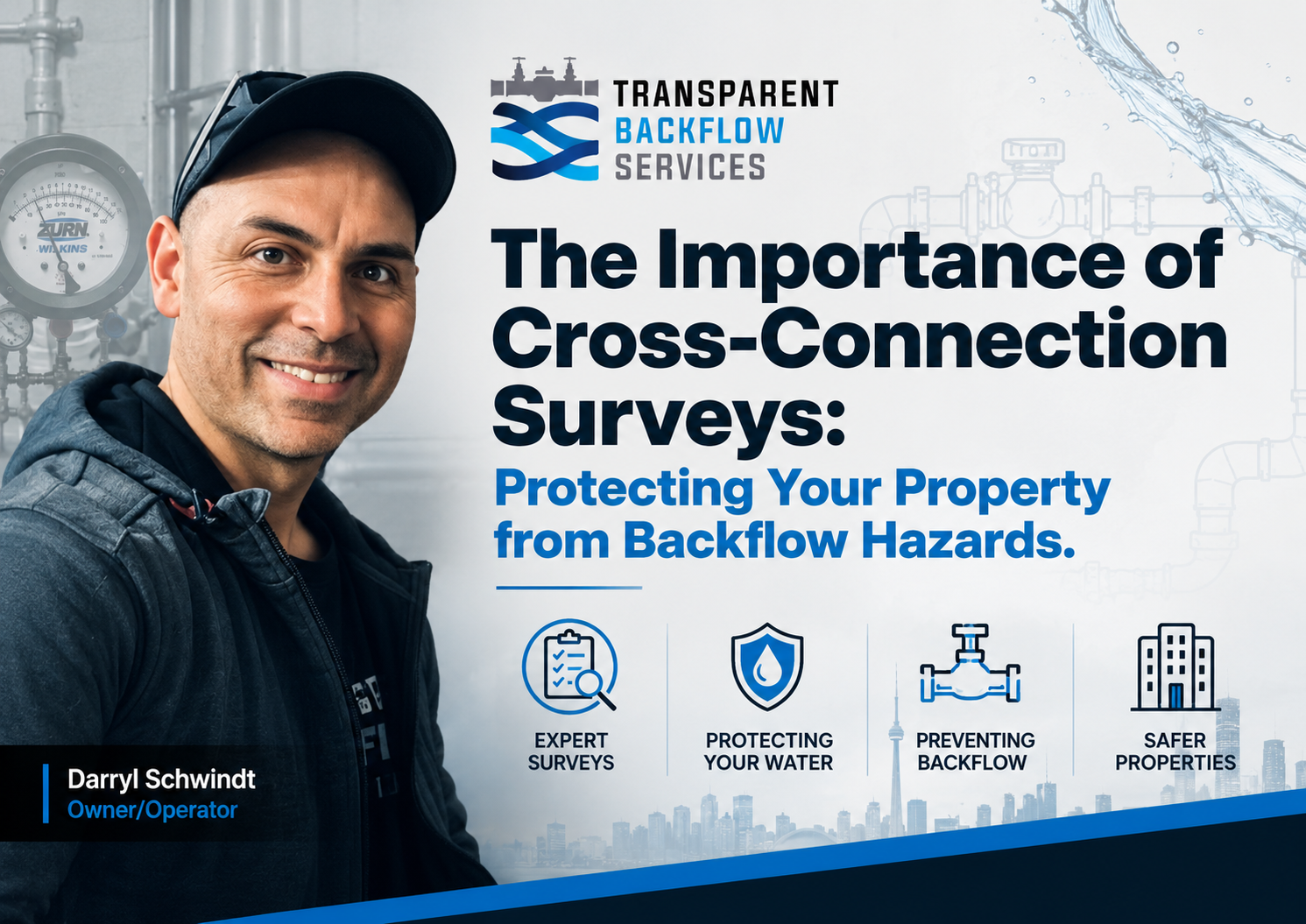
Protecting Properties Across Guelph, Cambridge, Waterloo, and Southern Ontario from Backflow Hazards
A backflow prevention device can only protect a connection that has been identified.
That is why a cross-connection survey is one of the most important parts of a complete backflow prevention program.
Annual testing confirms whether a particular device is operating properly. A cross-connection survey answers a wider question:
Have all actual and potential backflow hazards throughout the property been identified and properly protected?
For commercial, industrial, institutional, and multi-residential properties in Cambridge, Guelph, Waterloo, and nearby municipalities are required to complete a cross-connection survey
Buildings rarely remain exactly as they were originally designed. Equipment is replaced. Tenants renovate their spaces. Production areas expand. Boilers, irrigation systems, chemical dispensers, and specialized equipment are connected to potable-water lines.
Over time, the plumbing system shown on an old blueprint may no longer reflect what is actually happening inside the property.
“A cross-connection survey is not simply a count of the backflow devices already installed. We follow the potable-water system through the property, identify where contamination could enter, and determine whether the existing protection fits the actual hazard. The most important connection may be the one the property owner did not know was there.”
Darryl Schwindt
Owner/Operator, Transparent Backflow Services
What Is a Cross-Connection?
A cross-connection is an actual or potential connection between a potable-water system and a source of contamination or pollution.
It does not have to be a permanent section of pipe.
Common cross-connections may involve potable water connected to:
Boilers and heating systems
Commercial dishwashers
Chemical dispensers
Irrigation systems
Fire sprinkler systems
Cooling towers
Laboratory equipment
Dental and medical equipment
Manufacturing machinery
Water-treatment equipment
Pools and decorative water features
Wash stations
Hoses placed inside drains, tanks, or chemical containers
A cross-connection does not necessarily mean contamination is occurring at that moment.
For a backflow incident to happen, there must generally be both a pathway and a pressure condition that allows water to reverse direction.
The survey is intended to find and control the pathway before a change in pressure creates a water-quality problem.
A Cross-Connection Survey Is Different from a Backflow Test
The services are related, but they serve different purposes.
Backflow Testing
A backflow test evaluates the operation of one installed device.
Depending on the assembly, the tester may check whether its isolation valves, check valves, and relief components operate within the required parameters.
The test answers:
Is this specific backflow prevention device functioning properly?
Cross-Connection Survey
A cross-connection survey examines the potable-water system throughout the property.
The survey considers:
Where potable water enters the building
Where the water travels
Which systems and equipment are connected
Where contamination could enter
Whether existing devices match the degree of hazard
Whether additional protection is required
Whether devices are missing, inaccessible, or incorrectly installed
Whether plumbing has changed since the previous survey
Whether municipal records match what is physically installed
A property can therefore have several devices that pass their annual tests while still containing an unprotected cross-connection elsewhere.
Testing confirms device effectiveness.
A survey examines the entire plumbing risk.
Why Surveys Matter Across Guelph, Cambridge, and Waterloo
Municipal backflow programs generally place responsibility for private plumbing and cross-connection control on the property owner.
Although the forms, timelines, and administrative procedures can differ between municipalities, the purpose is consistent: identify connections that could allow contaminated water to enter the potable-water system and ensure suitable protection is installed.
Guelph
The City of Guelph requires applicable properties to complete cross-connection control surveys according to its Backflow Prevention Program and municipal bylaw.
The survey records existing backflow devices, identifies actual and potential cross-connections and outlines upgrades needed for compliance.
Devices connected to irrigation and fire sprinkler systems must also be included.
Cambridge
Cambridge's backflow prevention program applies to many commercial, industrial, institutional and larger multi-residential properties, along with applicable irrigation systems.
Property owners may be required to arrange surveys, device testing, and corrective work based on the building’s use and identified hazards.
Waterloo
Waterloo also requires applicable properties to complete cross-connection surveys and keep their plumbing information current.
Changes in building use, machinery, fixtures or piping may create the need for an updated assessment rather than waiting for the next scheduled survey cycle.
This is an important point for property owners throughout Southern Ontario.
A survey should reflect the property as it operates now—not simply the way it was configured several years ago.
Why an Existing Backflow Preventer May Not Be Enough
A device installed near the water meter can create a false sense of security.
Premise isolation is important because it helps protect the municipal drinking-water system from hazards within the property.
However, premise isolation may not protect people inside the building from an internal cross-connection.
Consider a chemical dispenser connected to potable water in one section of a facility.
A premise backflow preventer serving the building may help stop contaminated water from moving into the municipal water main, but it will not prevent that water from reaching plumbing fixtures elsewhere inside the property.
That is why a complete survey may consider several levels of protection.
Premise Isolation
A backflow device installed near the point where the municipal water service enters the property.
Its primary purpose is to protect the public water supply from conditions inside the building.
Source or Individual Isolation
Protection installed close to a specific fixture, machine, or source of contamination.
This helps stop backflow near the point where the hazard originates.
Zone or Area Isolation
Protection used to separate a section of the plumbing system containing one or more hazards.
The correct arrangement depends on the property, the piping design, the equipment, and the degree of hazard involved.
A qualified surveyor does not simply ask whether a device exists.
The survey determines whether the correct protection exists in the correct location.
What Should a Professional Cross-Connection Survey Include?
A useful survey begins where water enters the property and follows the potable-water system throughout the building.
Water-Service Entrance
The surveyor may review:
The water meter
Branches before the backflow device
The premise-isolation backflow devices
The backflow device accessibility for testing and repairs
The backflow device identification
The backflow device tags
Whether the installation matches municipal records
Mechanical Rooms
Mechanical rooms often contain multiple possible hazards in a relatively small area.
The survey may examine:
Boilers
Glycol systems
Cooling towers
Trap seal primers
Irrigation system feed
Water-treatment equipment
Humidifiers
Fire protection connections
Janitorial and Maintenance Areas
Utility rooms frequently change over time as new equipment is added.
Likely concerns include:
Chemical dispensers
Mop sinks
Commercial Kitchens
Restaurants and food-service properties may contain numerous water-fed appliances and systems.
A survey may examine:
Commercial dishwashers
Carbonated beverage equipment
Ice machines
Coffee equipment
Steam appliances
Food-processing equipment
Detergent and rinse-agent dispensers
The issue is not simply whether water reaches the equipment, but whether anything connected with that equipment could flow back into the potable-water system.
Healthcare, Dental and Laboratory Properties
Medical and laboratory buildings may contain specialized equipment presenting moderate or severe hazards.
The survey may review:
Dental Vacuums
Sterilizers
Autoclaves
Laboratory sinks
Aspirators
Medical washing equipment
Water-treatment systems
Chemical and biological equipment
These properties often require careful source isolation because of the chemicals and biological materials involved.
Exterior Systems
A thorough survey should also include exterior connections.
These may involve:
Irrigation systems
Private hydrants
Fire-service connections
Wash bays
Pools
Decorative fountains
Exterior hose connections
Auxiliary water supplies
Seasonal equipment
Real Incidents Show Why the Entire System Matters
An Ontario Connection Led to a Boil-Water Advisory
A documented Ontario incident occurred in MacTier after a contractor connected a sewage pump to the municipal drinking-water system.
That connection led to a boil-water advisory.
This example did not begin with an old device quietly failing during annual testing. It involved a connection created while work was being completed at the property.
It shows why temporary connections, contractor work, and newly installed equipment must be reviewed carefully.
A Mechanical-System Connection Reached Hospital Equipment
A documented medical-center incident involved an ethylene-glycol mixture from an air-conditioning system entering potable-water piping and reaching dialysis equipment.
A hospital investigation found that a direct connection between potable water and a chilled-water system allowed ethylene glycol into the building’s water when a check valve failed.
These incidents demonstrate an important principle.
The problem was not only that a mechanical component failed. Potable water had been connected to a chemically treated system in a way that created a contamination pathway.
A cross-connection survey is intended to find that pathway.
Backflow Events May Go Unnoticed
Not every backflow event produces an obvious smell, colour or taste.
Some incidents may be brief or limited to one part of a property. Contamination may clear before sampling occurs, or the affected fixture may not be tested.
This is why waiting for an employee, tenant, or customer to complain is not a reliable water-safety strategy.
Prevention depends on identifying the cross-connection before an incident occurs.
Property Changes That Should Trigger a New Review
A survey schedule should not be treated as permission to ignore changes made between survey dates.
Arrange a review when:
A new tenant occupies the property
The building changes use
Production equipment is added or relocated
Plumbing renovations are completed
A boiler or cooling system is replaced
Chemical-dispensing equipment is installed
The fire protection system changes
Irrigation is added
A storage tank, cistern, or auxiliary supply is introduced
Commercial kitchen equipment is connected
Medical or dental equipment is installed
A backflow device is removed, relocated or bypassed
The building is expanded
A change that appears minor from an operational perspective may create a new water connection with a different hazard classification.
Common Problems Found During Surveys
Equipment Installed Without a Backflow Review
An equipment supplier or contractor may connect a machine to water without considering municipal cross-connection requirements.
The machine may function correctly while still creating a possible pathway for contamination.
Built-In Protection That Is Not Sufficient
Some equipment includes an internal check valve or other protective component.
That does not automatically mean it provides the level of protection required by municipal rules or applicable standards.
The complete connection still needs to be assessed.
Devices That Cannot Be Serviced Properly
A backflow prevention assembly may be:
Positioned in a ceiling
Blocked by equipment
Exposed to freezing
Surrounded by stored materials
Installed without suitable service clearance
A compliant device must remain accessible for testing, repairs and future replacement.
Missing or Inaccurate Records
A previous contractor may have installed, removed, or replaced a device without updating the property’s documentation.
The survey helps compare what physically exists with the information held by the property owner and municipality.
Temporary Connections That Became Permanent
A hose, jumper line, or portable piece of equipment may be introduced for a short-term need and then remain in place.
Temporary connections should not be ignored simply because they are not permanently piped.
Incorrect Device for the Hazard
Backflow protection must correspond with the degree of hazard.
A device suitable for a minor concern may not provide adequate protection where contamination could create a serious health risk.
The survey should identify both the connection and the nature of the potential contaminant.
What Happens After the Survey?
A useful survey should give the property owner a clear understanding of what exists and what needs attention.
The following steps may include:
Documenting existing backflow devices
Identifying unprotected cross-connections
Determining the degree of hazard
Recommending premise, source, zone, or individual isolation
Installing required backflow preventers
Obtaining applicable permits
Updating property records
Submitting municipal documentation
Questions to Ask a Cross-Connection Surveyor
A cross-connection survey requires more than general plumbing experience.
Before hiring a contractor, ask:
Are you authorized to complete surveys in this municipality?
Is your cross-connection control certification current?
Are you familiar with local backflow bylaws?
Will you inspect the complete potable-water system?
Will every existing device be documented?
Will you explain the hazards and recommended corrections?
Can you complete installations where required?
Will you assist with municipal forms and records?
Will the property owner receive a clear copy of the completed survey?
The survey should produce more than a signed form.
It should give the owner or facility manager a sound understanding of the property’s backflow risks.
Cross-Connection Surveys Across Southern Ontario
Transparent Backflow Services provides cross-connection surveys, backflow testing, repairs, and installations for commercial, industrial, institutional, and multi-residential properties throughout:
Guelph
Kitchener
Cambridge
Waterloo
Surrounding Southern Ontario Municipalities
The survey process is based on how the property actually operates.
Transparent Backflow Services inspects the potable-water and fire systems, and explains what needs to be corrected.
Where upgrades are required, they can help coordinate the later steps so property owners have a practical route toward compliance.
Services include:
Cross-connection control surveys
Backflow testing
Backflow repairs
Backflow installations
A Survey Finds What a Device Test Cannot
Annual testing is still essential.
However, a test can only evaluate the device placed in front of the tester.
It cannot find an unprotected connection in another room, a hose added by a contractor, or a new machine connected after the previous inspection.
That is the value of a cross-connection survey.
It looks beyond an individual device and examines the path potable water takes throughout the property.
For property owners in Guelph, Cambridge, Waterloo and surrounding Southern Ontario municipalities, a survey is both a compliance responsibility and an opportunity to identify problems before an unnoticed plumbing change becomes a water-quality concern.
Schedule a Cross-Connection Survey
For professional cross-connection surveys, backflow testing, repairs, or installations in Guelph, Cambridge,Waterloo, and surrounding Southern Ontario municipalities, contact Transparent Backflow Services.
Identify hidden hazards. Protect clean water. Keep your property compliant.